Eclipses›Solar eclipses›January 26, 2028

Annular solar eclipse of January 26, 2028

The Moon passes in front of the Sun while it is too far from the Earth to cover it all: inside a narrow path a ring of sunlight is left around it. Around the path, a much wider part of the world sees a partial eclipse.

Where it is seen

Annular along a path across the Pacific, South America, the Atlantic, Africa, Europe and the Mediterranean; partial over South America, North America, Africa, Europe and Greenland.

Drawing the eclipse…

Moon’s shadow

Drawing the eclipse…

Times are in your own time zone. Drag the globe to turn it; the slider moves the eclipse.

Times and facts

Date
Wednesday, January 26, 2028
Greatest eclipse
15:07 over South America
Where it is greatest
3.0° N, 51.5° W
Longest annular phase
10 min 27 s
Width of the path
323 km at greatest eclipse
Partial eclipse begins
12:06 first place on Earth
Path begins
13:14 at sunrise
Path ends
17:00 at sunset
Partial eclipse ends
18:08 last place on Earth

Times are UTC. A lunar eclipse happens at the same instant everywhere; a solar eclipse reaches each place at its own time, given below.

Cities inside the path

Of the cities this site covers, these see the annular phase. Times are local to each city.

CityLastsFromUntilLocal dateSun
Seville · Spain7 min 13 s17:52:1517:59:28Wed, Jan 267° up
Manaus · Brazil7 min 13 s10:24:2410:31:37Wed, Jan 2660° up
Córdoba · Spain7 min 11 s17:52:3417:59:44Wed, Jan 266° up
Valencia · Spain7 min 00 s17:53:2118:00:21Wed, Jan 262° up
Barcelona · Spain5 min 54 s17:53:2117:59:15Wed, Jan 26On the horizon
Palma · Spain5 min 13 s17:54:4818:00:01Wed, Jan 26On the horizon
Alicante · Spain4 min 59 s17:54:4717:59:46Wed, Jan 263° up
Málaga · Spain4 min 52 s17:54:1117:59:03Wed, Jan 266° up
Murcia · Spain4 min 32 s17:54:5817:59:30Wed, Jan 263° up

The edge of the path is known to within a kilometre or two. A city that gets only a few seconds is on that edge: go towards the middle of the path to be sure.

Cities that see a partial eclipse

324 of the cities this site covers see something of this eclipse; these are the 40 largest outside the path. Times are local to each city.

CitySeesFromMaximumUntilLocal dateSun
Madrid · Spain82% covered16:3617:5518:25 sunsetWed, Jan 264° up
Rabat · Morocco81% covered15:3316:5617:51 sunsetWed, Jan 2610° up
Casablanca · Morocco80% covered15:3216:5517:55 sunsetWed, Jan 2610° up
Algiers · Algeria77% covered4:42 PM5:58 PM6:06 PM sunsetWed, Jan 26On the horizon
Cali · Colombia67% covered7:18 AM8:49 AM10:44 AMWed, Jan 2634° up
Lima · Peru65% covered7:11 AM8:37 AM10:22 AMWed, Jan 2636° up
Bogotá · Colombia64% covered7:22 AM8:57 AM10:55 AMWed, Jan 2637° up
Medellín · Colombia59% covered7:23 AM8:55 AM10:50 AMWed, Jan 2635° up
Paris · France58% covered16:3717:3717:37 sunsetWed, Jan 26On the horizon
London · United Kingdom53% covered15:3516:3816:38 sunsetWed, Jan 26On the horizon
Caracas · Venezuela51% covered8:44 AM10:28 AM12:29 PMWed, Jan 2646° up
Fortaleza · Brazil46% covered10:3712:2814:08Wed, Jan 2672° up
Dakar · Senegal44% covered15:1016:3917:54Wed, Jan 2631° up
Mexico City · Mexico36% covered7:12 AM sunrise7:35 AM8:52 AMWed, Jan 264° up
Ecatepec · Mexico36% covered7:12 AM sunrise7:35 AM8:52 AMWed, Jan 264° up
Brasília · Brazil35% covered10:0111:4013:19Wed, Jan 2679° up
Santo Domingo · Dominican Republic31% covered9:00 AM10:33 AM12:20 PMWed, Jan 2640° up
Rome · Italy28% covered16:4517:1617:16 sunsetWed, Jan 26On the horizon
Conakry · Guinea25% covered15:2116:3717:42Wed, Jan 2631° up
Salvador · Brazil25% covered10:3412:0813:36Wed, Jan 2682° up
Havana · Cuba21% covered7:54 AM9:05 AM10:29 AMWed, Jan 2623° up
Belo Horizonte · Brazil19% covered10:1911:4213:05Wed, Jan 2684° up
São Paulo · Brazil14% covered10:1611:3112:47Wed, Jan 2678° up
Houston · TX14% covered7:14 AM sunrise7:55 AM8:58 AMWed, Jan 267° up
Curitiba · Brazil13% covered10:1211:2312:36Wed, Jan 2673° up
Rio de Janeiro · Brazil12% covered10:2811:3912:51Wed, Jan 2683° up
Hamburg · Germany6% covered16:3816:4916:49 sunsetWed, Jan 26On the horizon
Kano · Nigeria6% covered17:1517:5418:25 sunsetWed, Jan 266° up
Abidjan · Côte d’Ivoire5% covered15:5816:4117:20Wed, Jan 2623° up
Santiago · Chile5% covered10:00 AM10:44 AM11:32 AMWed, Jan 2645° up
Kaduna · Nigeria4% covered17:1717:5218:26Wed, Jan 268° up
Philadelphia · PA3% covered9:12 AM9:57 AM10:43 AMWed, Jan 2623° up
New York · NY3% covered9:17 AM10:01 AM10:47 AMWed, Jan 2624° up
Accra · Ghana3% covered4:11 PM4:44 PM5:15 PMWed, Jan 2619° up
Ibadan · Nigeria2% covered17:1817:4818:17Wed, Jan 2614° up
Lagos · Nigeria2% covered17:2117:4718:13Wed, Jan 2615° up
Buenos Aires · Argentina2% covered10:28 AM11:01 AM11:36 AMWed, Jan 2658° up
Chicago · IL1% covered8:01 AM8:32 AM9:04 AMWed, Jan 2612° up
Montreal · Canada1% covered9:38 AM10:10 AM10:42 AMWed, Jan 2621° up
Toronto · Canadaunder 1% covered9:24 AM9:53 AM10:23 AMWed, Jan 2618° up

Find another city

Protect your eyes

Looking at the Sun without protection damages the eye, eclipsed or not. Use eclipse glasses or a solar filter made for the purpose (ISO 12312-2) whenever any part of the Sun is showing; sunglasses are not enough. In this eclipse some of the Sun is showing from start to end, everywhere.
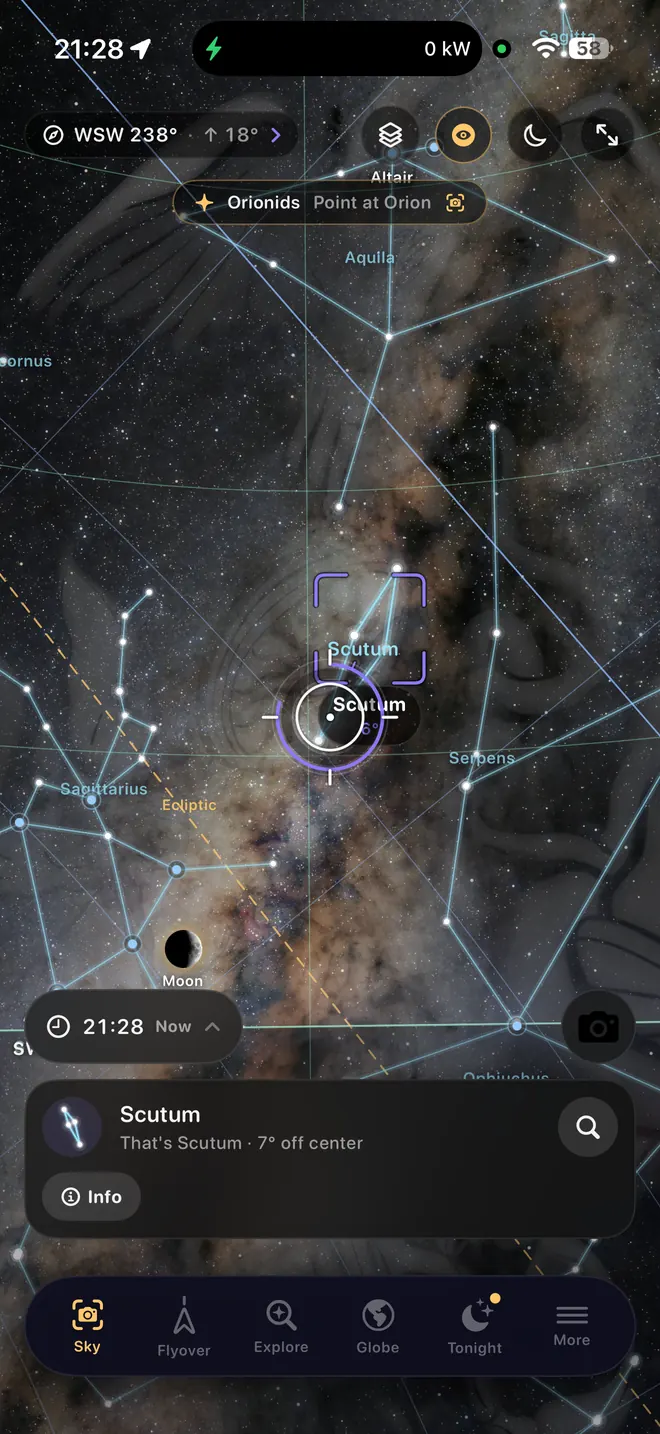
The app’s sky view, with constellation figures drawn over the stars

With the app

Years away, and easy to forget. The app reminds you the day before.

This page tells you when to look. The app tells you again when it matters, and shows you where in your own sky.

  • An alert the day before an eclipse you can see, and another an hour before its deepest moment.
  • Set the sky to the minute of the eclipse and see where the Sun or the Moon will stand, from where you are.
  • An arrow in the camera view that leads you to the Moon, a planet or any star.
  • Meteor showers, oppositions and supermoons in the same calendar.
Download on the App Store

Quick answers

Where is the annular solar eclipse of January 26, 2028 visible?

Annular along a path across the Pacific, South America, the Atlantic, Africa, Europe and the Mediterranean; partial over South America, North America, Africa, Europe and Greenland.

What time is the solar eclipse on January 26, 2028?

The Moon’s shadow first touches the Earth at 12:06 UTC and leaves it at 18:08 UTC. The eclipse is at its greatest at 15:07 UTC, over South America. When you see it depends on where you are: each city’s page gives its own times.

How long does the ring of fire last?

At most 10 min 27 s, on the middle of the path over South America, where the path is about 323 km wide. It is shorter towards the edges of the path and towards its two ends.

Which cities are inside the path of the annular solar eclipse?

Of the cities this site covers: Seville (7 min 13 s), Manaus (7 min 13 s), Córdoba (7 min 11 s), Valencia (7 min 00 s), Barcelona (5 min 54 s), Palma (5 min 13 s), Alicante (4 min 59 s), Málaga (4 min 52 s) and 1 more.

Is it safe to look at this eclipse?

Only through eclipse glasses or a solar filter made for the purpose, from the first moment to the last. Some of the Sun is showing throughout, and sunglasses are not enough.

More eclipses