Eclipses›Solar eclipses›February 27, 2036

Partial solar eclipse of February 27, 2036

The middle of the Moon’s shadow misses the Earth, so nowhere is the Sun covered completely. Those under the outer shadow see the Moon take a bite out of the Sun.

Where it is seen

Partial over New Zealand, Antarctica and the Tasman Sea.

Drawing the eclipse…

Moon’s shadow

Drawing the eclipse…

Times are in your own time zone. Drag the globe to turn it; the slider moves the eclipse.

Times and facts

Date
Wednesday, February 27, 2036
Greatest eclipse
04:45 over Antarctica
Where it is greatest
71.8° S, 131.4° W
Most of the Sun covered
52%
Partial eclipse begins
02:47 first place on Earth
Partial eclipse ends
06:43 last place on Earth

Times are UTC. A lunar eclipse happens at the same instant everywhere; a solar eclipse reaches each place at its own time, given below.

What cities see

16 of the cities this site covers see something of this eclipse; these are all of them. Times are local to each city.

CitySeesFromMaximumUntilLocal dateSun
Dunedin · New Zealand23% covered5:44 PM6:41 PM7:34 PMWed, Feb 2718° up
Christchurch · New Zealand21% covered5:51 PM6:46 PM7:37 PMWed, Feb 2716° up
Wellington · New Zealand19% covered5:58 PM6:51 PM7:39 PMWed, Feb 2714° up
Tauranga · New Zealand15% covered6:09 PM6:57 PM7:42 PMWed, Feb 2711° up
Hamilton · New Zealand15% covered6:09 PM6:57 PM7:42 PMWed, Feb 2712° up
Auckland · New Zealand14% covered6:12 PM6:59 PM7:42 PMWed, Feb 2712° up
Hobart · Australia7% covered3:47 PM4:34 PM5:18 PMWed, Feb 2736° up
Launceston · Australia6% covered3:54 PM4:37 PM5:18 PMWed, Feb 2736° up
Geelong · Australia1% covered4:13 PM4:42 PM5:09 PMWed, Feb 2739° up
Melbourne · Australia1% covered4:14 PM4:43 PM5:11 PMWed, Feb 2738° up
Wollongong · Australia1% covered4:30 PM4:55 PM5:20 PMWed, Feb 2732° up
Canberra · Australia1% covered4:26 PM4:52 PM5:17 PMWed, Feb 2734° up
Sydney · Australiaunder 1% covered4:33 PM4:57 PM5:20 PMWed, Feb 2732° up
Ballarat · Australiaunder 1% covered4:18 PM4:42 PM5:06 PMWed, Feb 2739° up
Newcastle · Australiaunder 1% covered4:39 PM4:59 PM5:18 PMWed, Feb 2731° up
Bendigo · Australiaunder 1% covered4:23 PM4:45 PM5:05 PMWed, Feb 2739° up

Find another city

Protect your eyes

Looking at the Sun without protection damages the eye, eclipsed or not. Use eclipse glasses or a solar filter made for the purpose (ISO 12312-2) whenever any part of the Sun is showing; sunglasses are not enough. In this eclipse some of the Sun is showing from start to end, everywhere.
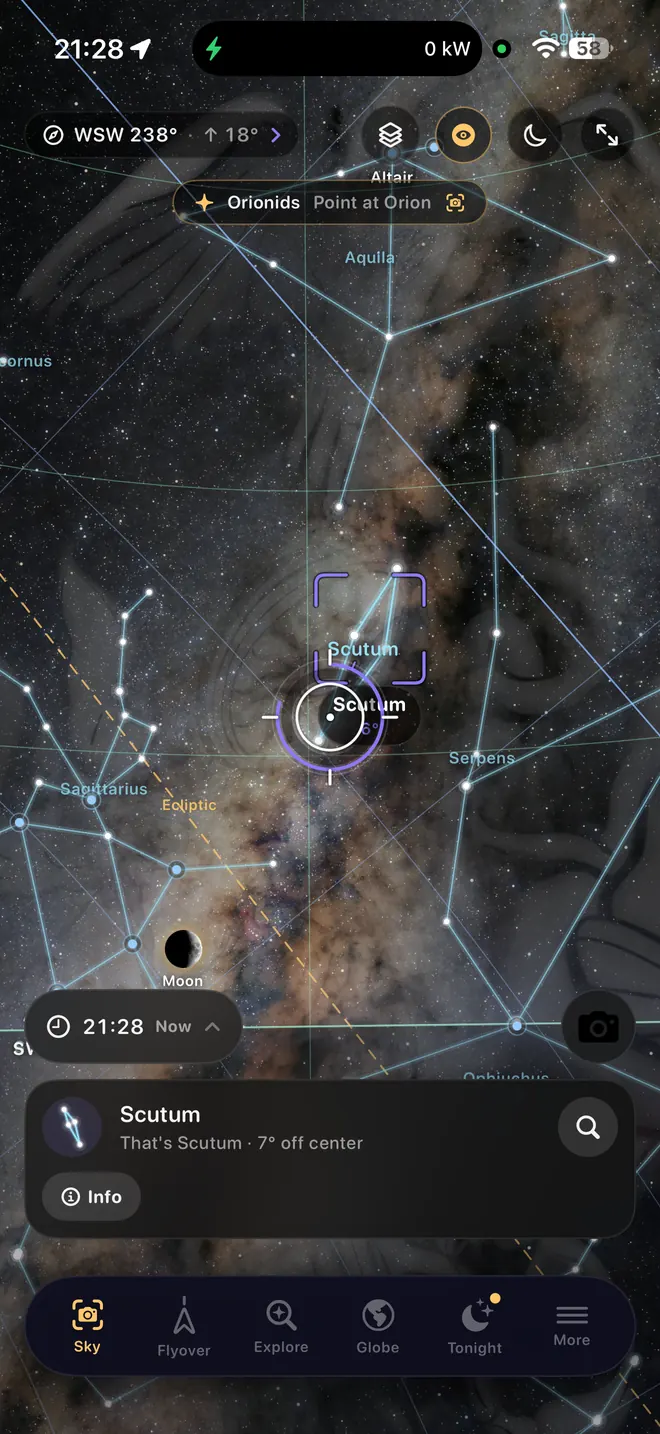
The app’s sky view, with constellation figures drawn over the stars

With the app

Years away, and easy to forget. The app reminds you the day before.

This page tells you when to look. The app tells you again when it matters, and shows you where in your own sky.

  • An alert the day before an eclipse you can see, and another an hour before its deepest moment.
  • Set the sky to the minute of the eclipse and see where the Sun or the Moon will stand, from where you are.
  • An arrow in the camera view that leads you to the Moon, a planet or any star.
  • Meteor showers, oppositions and supermoons in the same calendar.
Download on the App Store

Quick answers

Where is the partial solar eclipse of February 27, 2036 visible?

Partial over New Zealand, Antarctica and the Tasman Sea.

What time is the solar eclipse on February 27, 2036?

The Moon’s shadow first touches the Earth at 02:47 UTC and leaves it at 06:43 UTC. The eclipse is at its greatest at 04:45 UTC, over Antarctica. When you see it depends on where you are: each city’s page gives its own times.

How much of the Sun is covered?

At most 52% of the Sun’s disc, as seen from Antarctica. Nowhere on Earth sees this eclipse as total.

Is it safe to look at this eclipse?

Only through eclipse glasses or a solar filter made for the purpose, from the first moment to the last. Some of the Sun is showing throughout, and sunglasses are not enough.

More eclipses