Without a telescope
Not with the naked eyeIt needs binoculars or a telescope: magnitude +6.8 at its best, and the faintest stars the eye can see are about magnitude +6.
 Star & Planet Finder
Satellites›Brightest satellites›ALOS-2
ALOS-2 is a satellite from Japan, launched on May 24, 2014 from Tanegashima, Japan. It is in a low orbit, 631 km above the ground, and goes around the Earth every 97.3 minutes: 14.8 times a day, at 7.54 km/s (27,100 km/h). The orbit is sun-synchronous: it crosses every place at about the same local time of day.
The gold ring is its orbit, and the line drops to the point on the ground under it. Inside the white circle it is above the horizon. Drag the globe to turn it, pinch or use the buttons to come closer; the target button brings you back to the satellite. The 2D map shows its path over the ground for the next lap: gold where it is in sunlight, dashed where it is in Earth’s shadow.
Finding ALOS-2…
Finding ALOS-2…
It needs binoculars or a telescope: magnitude +6.8 at its best, and the faintest stars the eye can see are about magnitude +6.
Its orbit crosses close to both poles, so sooner or later it passes over every place on Earth.
A satellite shows only when your sky is dark and it is still in sunlight: in the hours after dusk and before dawn.
The app works out its passes over your exact location, alerts you before one, and leads you to it with an arrow in the camera view.
Orbit measured November 12, 2026, from CelesTrak. Heights are above the ground at the equator. Page updated November 14, 2026.
The map on this page shows where ALOS-2 is at this moment, the path it will follow over the ground for the next lap, and the part of the Earth it is above the horizon for. It is worked out from the latest tracking data.
About 631 km above the ground.
About 7.54 km/s, which is 27,100 km/h. One lap of the Earth takes it 97.3 minutes, so it goes around 14.8 times a day.
Not with the naked eye. It needs binoculars or a telescope: magnitude +6.8 at its best, and the faintest stars the eye can see are about magnitude +6.
On May 24, 2014, from Tanegashima, Japan.
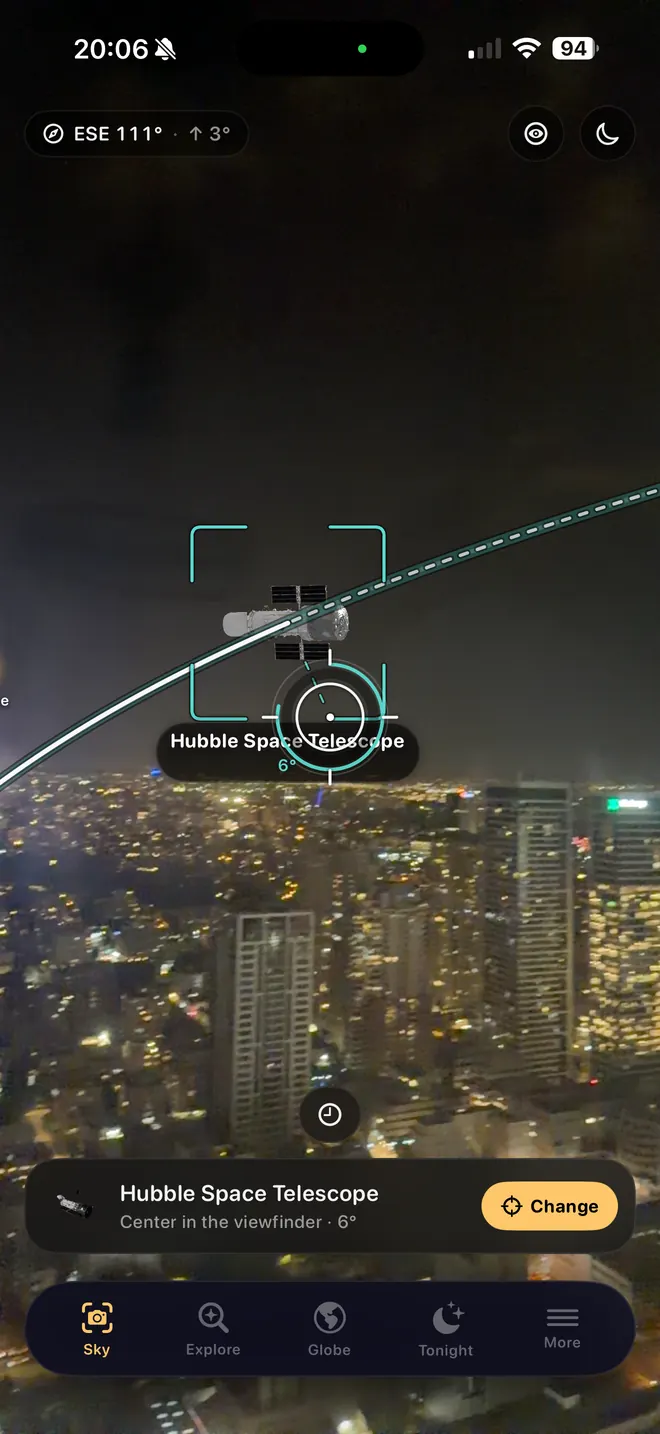
With the app
This page follows the satellite around the planet. The app works out when it passes over you, and leads you to it.