Sun
- Sunset
- 5:23 PM
- Dark from
- 5:51 PM
- Dark until
- 6:44 AM
- Sunrise
- 7:12 AM
 Star & Planet Finder
Tonight’s sky›South Korea›Incheon
Saturday, November 14, 2026. Which planets are up, where to look and when, the Moon, and the brightest stars - for the naked eye, no telescope needed.
Sun
Moon
24% lit. Sets 9:00 PM.
A good night for faint stars.
Space station
The station is not in the right place at the right time over Incheon tonight.
Next passes over IncheonA planet shines with a steady light; stars twinkle. Times are local to Incheon and tell you when each planet is at least 10° above the horizon in a dark sky.
Look east-southeast, 20° up, at 6:41 AM
Look south, 66° up, at 6:41 AM
Look east-southeast, 10° up, at 6:41 AM
Look south, 53° up, at 9:31 PM
Look south, 67° up, at 6:41 AM
The first stars to appear as the sky darkens, and where each one stands.
| Star | Direction | Height |
|---|---|---|
| Vega | west-northwest | 38° up |
| Capella | northeast | 24° up |
| Altair | west-southwest | 37° up |
| Aldebaran | east | 16° up |
| Fomalhaut | south | 23° up |
| Deneb | west-northwest | 62° up |
Constellations high in the sky at that hour: Lacerta, Pegasus, Andromeda, Cygnus, Pisces, Cassiopeia, Cepheus, Triangulum.
Computed Saturday, November 14, 2026.
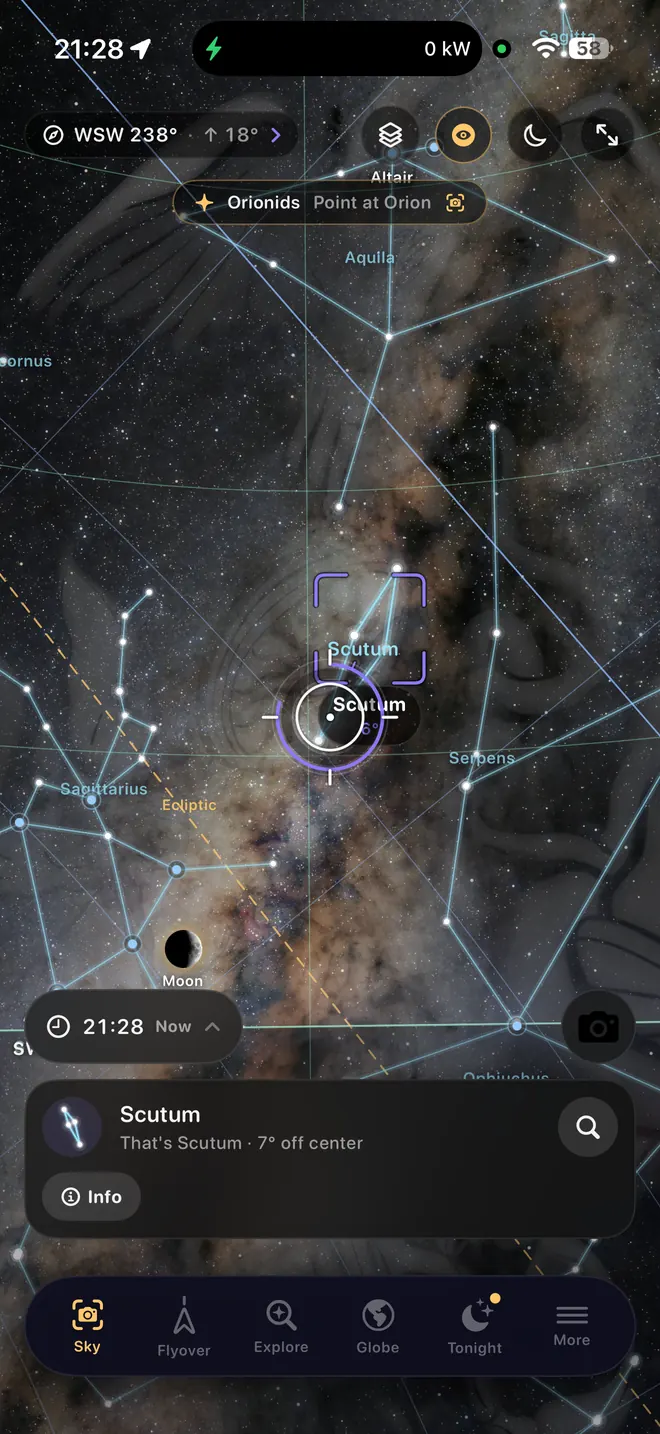
With the app
A list tells you what is up. The app shows you where, over the real sky.
On the night of Saturday, November 14, 2026: Venus (look east-southeast at 6:41 AM), Jupiter (look south at 6:41 AM), Mercury (look east-southeast at 6:41 AM), Saturn (look south at 9:31 PM) and Mars (look south at 6:41 AM).
Waxing crescent, 24% lit, on the night of Saturday, November 14, 2026. It is up for at least part of the time the sky is dark.
On Saturday, November 14, 2026 the Sun sets at 5:23 PM, and the sky is dark enough for the planets and bright stars from 5:51 PM until 6:44 AM.