Sun
- Sunset
- 18:13
- Dark from
- 18:37
- Dark until
- 04:36
- Sunrise
- 05:00
 Star & Planet Finder
Tonight’s sky›Brazil›Rio de Janeiro
Saturday, November 14, 2026. Which planets are up, where to look and when, the Moon, and the brightest stars - for the naked eye, no telescope needed.
Sun
Moon
28% lit. Sets 22:52.
A good night for faint stars.
Space station
From the east-northeast, 14° high at its best, gone by 02:51.
Next passes over Rio de JaneiroA planet shines with a steady light; stars twinkle. Times are local to Rio de Janeiro and tell you when each planet is at least 10° above the horizon in a dark sky.
Look east, 15° up, at 04:27
Look northeast, 46° up, at 04:27
Look north, 66° up, at 20:47
Look northeast, 45° up, at 04:27
Not visible tonight: Mercury - too close to the Sun in the sky, or below the horizon while it is dark.
The first stars to appear as the sky darkens, and where each one stands.
| Star | Direction | Height |
|---|---|---|
| Achernar | south-southeast | 48° up |
| Altair | west-northwest | 30° up |
| Fomalhaut | southwest | 82° up |
| Lambda Scorpii | southwest | 16° up |
Constellations high in the sky at that hour: Piscis Austrinus, Sculptor, Aquarius, Grus, Phoenix, Capricornus, Microscopium, Cetus.
Computed Saturday, November 14, 2026.
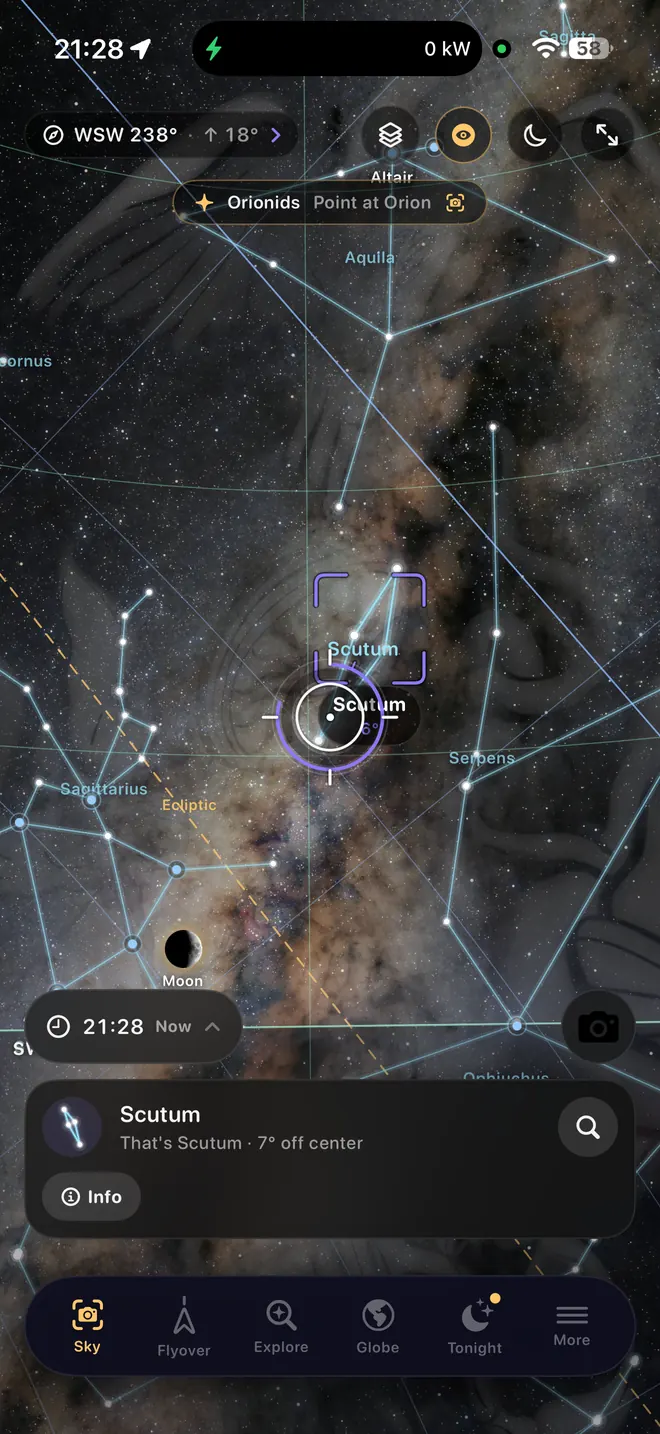
With the app
A list tells you what is up. The app shows you where, over the real sky.
On the night of Saturday, November 14, 2026: Venus (look east at 04:27), Jupiter (look northeast at 04:27), Saturn (look north at 20:47) and Mars (look northeast at 04:27). Not visible that night: Mercury.
Waxing crescent, 28% lit, on the night of Saturday, November 14, 2026. It is up for at least part of the time the sky is dark.
On Saturday, November 14, 2026 the Sun sets at 18:13, and the sky is dark enough for the planets and bright stars from 18:37 until 04:36.