Eclipses›Solar eclipses›February 6, 2027

Annular solar eclipse of February 6, 2027

The Moon passes in front of the Sun while it is too far from the Earth to cover it all: inside a narrow path a ring of sunlight is left around it. Around the path, a much wider part of the world sees a partial eclipse.

Where it is seen

Annular along a path across the Pacific, South America, the Atlantic and Africa; partial over Africa, South America and Antarctica.

Drawing the eclipse…

Moon’s shadow

Drawing the eclipse…

Times are in your own time zone. Drag the globe to turn it; the slider moves the eclipse.

Times and facts

Date
Saturday, February 6, 2027
Greatest eclipse
15:59 over South America
Where it is greatest
31.3° S, 48.5° W
Longest annular phase
7 min 51 s
Width of the path
280 km at greatest eclipse
Partial eclipse begins
12:57 first place on Earth
Path begins
14:03 at sunrise
Path ends
17:55 at sunset
Partial eclipse ends
19:01 last place on Earth

Times are UTC. A lunar eclipse happens at the same instant everywhere; a solar eclipse reaches each place at its own time, given below.

Cities inside the path

Of the cities this site covers, these see the annular phase. Times are local to each city.

CityLastsFromUntilLocal dateSun
Lagos · Nigeria5 min 35 s18:49:4218:55:17Sat, Feb 6On the horizon
Accra · Ghana5 min 30 s5:49:37 PM5:55:07 PMSat, Feb 64° up
Lomé · Togo5 min 18 s17:49:5917:55:17Sat, Feb 63° up
Ibadan · Nigeria2 min 40 s18:50:5818:53:38Sat, Feb 6On the horizon
Abidjan · Côte d’Ivoire58 s17:51:5917:52:57Sat, Feb 68° up

The edge of the path is known to within a kilometre or two. A city that gets only a few seconds is on that edge: go towards the middle of the path to be sure.

Cities that see a partial eclipse

63 of the cities this site covers see something of this eclipse; these are the 40 largest outside the path. Times are local to each city.

CitySeesFromMaximumUntilLocal dateSun
Montevideo · Uruguay86% covered10:50 AM12:36 PM2:18 PMSat, Feb 670° up
Rio de Janeiro · Brazil84% covered11:4013:2915:04Sat, Feb 669° up
Porto Alegre · Brazil83% covered11:0712:5614:38Sat, Feb 675° up
Buenos Aires · Argentina82% covered10:46 AM12:31 PM2:15 PMSat, Feb 669° up
São Paulo · Brazil78% covered11:3113:2114:59Sat, Feb 674° up
Port Harcourt · Nigeria77% covered17:4318:4418:44 sunsetSat, Feb 6On the horizon
Curitiba · Brazil76% covered11:2013:1114:51Sat, Feb 676° up
Belo Horizonte · Brazil76% covered11:4613:3515:10Sat, Feb 669° up
Monrovia · Liberia75% covered4:37 PM5:52 PM6:53 PM sunsetSat, Feb 614° up
Salvador · Brazil74% covered12:1714:0115:29Sat, Feb 658° up
Rosario · Argentina74% covered10:43 AM12:29 PM2:14 PMSat, Feb 670° up
Recife · Brazil71% covered12:3714:1615:40Sat, Feb 649° up
Ouagadougou · Burkina Faso67% covered16:4917:5718:09 sunsetSat, Feb 62° up
Córdoba · Argentina64% covered10:39 AM12:23 PM2:08 PMSat, Feb 668° up
Conakry · Guinea62% covered16:4017:5519:01Sat, Feb 615° up
Santiago · Chile62% covered10:26 AM12:04 PM1:49 PMSat, Feb 659° up
Bamako · Mali60% covered16:4717:5818:35 sunsetSat, Feb 68° up
Asunción · Paraguay58% covered11:03 AM12:52 PM2:35 PMSat, Feb 680° up
Brasília · Brazil57% covered11:5013:3815:12Sat, Feb 672° up
Kaduna · Nigeria57% covered17:4818:3518:35 sunsetSat, Feb 6On the horizon
Goiânia · Brazil56% covered11:4513:3315:08Sat, Feb 675° up
Fortaleza · Brazil53% covered12:4514:2115:42Sat, Feb 651° up
Yaoundé · Cameroon51% covered17:4318:2718:27 sunsetSat, Feb 6On the horizon
Kano · Nigeria45% covered17:4918:2918:29 sunsetSat, Feb 6On the horizon
Dakar · Senegal43% covered16:4817:5819:01Sat, Feb 616° up
Luanda · Angola42% covered17:3518:3418:34 sunsetSat, Feb 6On the horizon
Brazzaville · Congo - Brazzaville40% covered17:3918:2118:21 sunsetSat, Feb 6On the horizon
Kinshasa · Congo - Kinshasa40% covered17:3918:2118:21 sunsetSat, Feb 6On the horizon
Belém · Brazil26% covered12:4414:1215:27Sat, Feb 661° up
Manaus · Brazil7% covered11:3712:4513:46Sat, Feb 675° up
Casablanca · Morocco5% covered18:2819:0319:06 sunsetSat, Feb 6On the horizon
Rabat · Morocco5% covered18:2919:0219:02 sunsetSat, Feb 6On the horizon
Soweto · South Africa5% covered18:3618:5818:58 sunsetSat, Feb 6On the horizon
Johannesburg · South Africa5% covered18:3618:5718:57 sunsetSat, Feb 6On the horizon
Pretoria · South Africa5% covered18:3618:5518:55 sunsetSat, Feb 6On the horizon
Cape Town · South Africa2% covered18:3218:5719:22Sat, Feb 69° up
Lima · Peru2% covered9:32 AM10:17 AM11:04 AMSat, Feb 660° up
Lusaka · Zambia2% covered6:36 PM6:42 PM6:42 PM sunsetSat, Feb 6On the horizon
Durban · South Africa1% covered18:3918:5018:50 sunsetSat, Feb 6On the horizon
Port Elizabeth · South Africaunder 1% covered18:3918:5719:14Sat, Feb 64° up

Find another city

Protect your eyes

Looking at the Sun without protection damages the eye, eclipsed or not. Use eclipse glasses or a solar filter made for the purpose (ISO 12312-2) whenever any part of the Sun is showing; sunglasses are not enough. In this eclipse some of the Sun is showing from start to end, everywhere.
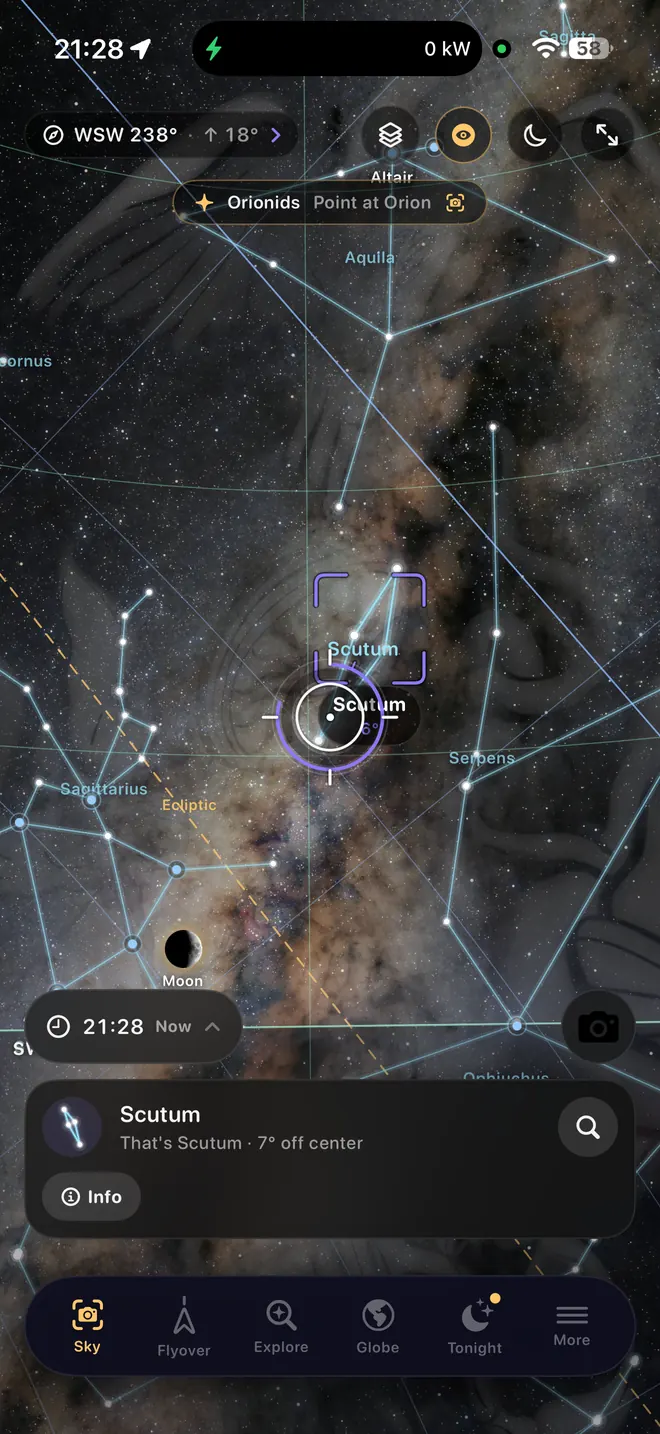
The app’s sky view, with constellation figures drawn over the stars

With the app

Years away, and easy to forget. The app reminds you the day before.

This page tells you when to look. The app tells you again when it matters, and shows you where in your own sky.

  • An alert the day before an eclipse you can see, and another an hour before its deepest moment.
  • Set the sky to the minute of the eclipse and see where the Sun or the Moon will stand, from where you are.
  • An arrow in the camera view that leads you to the Moon, a planet or any star.
  • Meteor showers, oppositions and supermoons in the same calendar.
Download on the App Store

Quick answers

Where is the annular solar eclipse of February 6, 2027 visible?

Annular along a path across the Pacific, South America, the Atlantic and Africa; partial over Africa, South America and Antarctica.

What time is the solar eclipse on February 6, 2027?

The Moon’s shadow first touches the Earth at 12:57 UTC and leaves it at 19:01 UTC. The eclipse is at its greatest at 15:59 UTC, over South America. When you see it depends on where you are: each city’s page gives its own times.

How long does the ring of fire last?

At most 7 min 51 s, on the middle of the path over South America, where the path is about 280 km wide. It is shorter towards the edges of the path and towards its two ends.

Which cities are inside the path of the annular solar eclipse?

Of the cities this site covers: Lagos (5 min 35 s), Accra (5 min 30 s), Lomé (5 min 18 s), Ibadan (2 min 40 s), Abidjan (58 s).

Is it safe to look at this eclipse?

Only through eclipse glasses or a solar filter made for the purpose, from the first moment to the last. Some of the Sun is showing throughout, and sunglasses are not enough.

More eclipses